China has a broad refrigeration equipment industry, serving cold storage, food processing, retail, and industrial cooling projects. This guide introduces ten Chinese manufacturers of Refrigeration Condensing Unit systems and offers a practical starting point for comparing suppliers. The right choice depends on more than a product photo or a quoted price. Buyers should check cooling capacity, operating conditions, refrigerant compatibility, compressor options, and control features against the needs of their installation.
Details matter. A unit may face high outdoor temperatures, long operating hours, or limited service access. Ask manufacturers for clear technical data, test information, warranty terms, and examples of comparable applications. Also consider coil construction, noise levels, energy performance, and the availability of replacement parts. These points can help distinguish a suitable system from one that merely looks competitive on paper. Not every supplier publishes the same level of detail, so verify important claims directly and request documentation before making a decision.
This list is a starting point, not a final verdict. A shortlist can still miss a strong regional supplier, and a prominent brand may not fit every project. Compare each company using consistent requirements, then confirm specifications with qualified refrigeration professionals. Careful checks take time. They can prevent costly mismatches later.
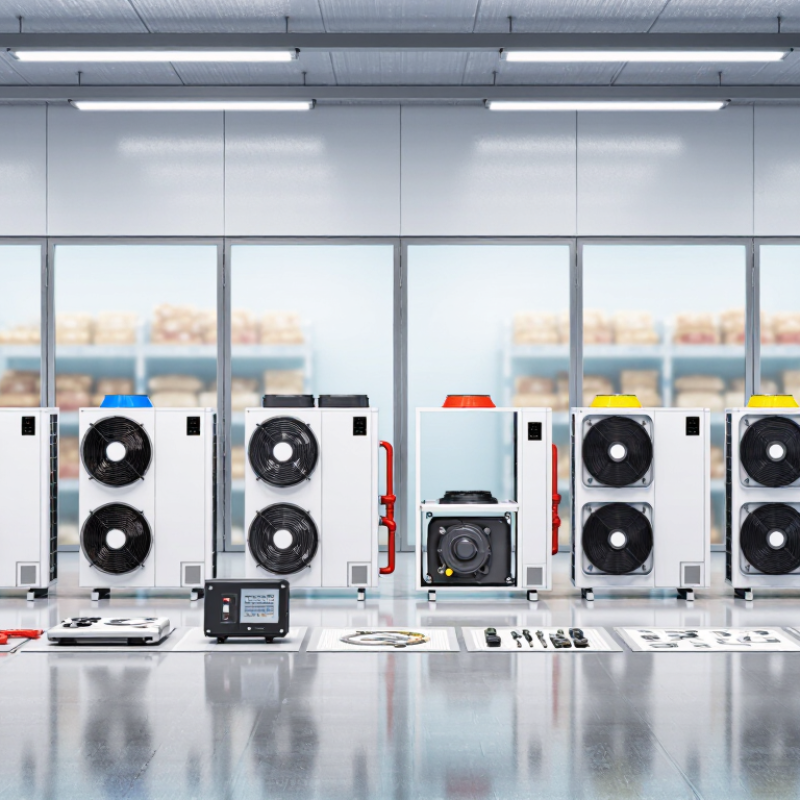
A refrigeration condensing unit moves heat out of a cooled space. It typically contains a compressor, condenser coil, fan, and electrical controls; some designs include a liquid receiver. Refrigerant returns from the evaporator as a low-pressure vapor. The compressor raises its pressure, and the condenser releases heat to the surrounding air or water. The refrigerant then continues through the circuit. The unit does not create cold by itself. It enables heat removal.
These units serve walk-in cold rooms, supermarket display cases, commercial kitchens, food-processing areas, and other temperature-controlled spaces. A small grocery cooler may use an air-cooled unit near the building exterior, while a larger facility may need several units matched to different loads. Sizing depends on product quantity, door openings, insulation, target temperature, and local conditions. Details matter. Dust-covered fins or poor airflow can reduce heat rejection, especially on a hot day. In practice, neat diagrams leave out awkward site constraints. A careful installation plan and regular inspection help keep temperatures stable.
China’s condensing-unit industry is not a single production chain. It combines equipment assemblers, component suppliers, engineering teams, and export-focused trading companies. Some factories build complete units, while others concentrate on compressors, heat exchangers, electrical controls, or sheet-metal housings. The final product depends on how well these parts work together. Details matter.
Manufacturers often organize production around customer requirements. A project team may confirm cooling capacity, refrigerant type, operating conditions, and installation space before production begins. Engineers then select components and prepare the unit layout. On the factory floor, workers assemble piping, mount controls, and check joints for leaks. Testing procedures vary, so buyers should ask what is measured and how results are recorded.
The supplier network can be regional, but capabilities differ between workshops. A large facility may offer consistent testing and documentation; a smaller factory may respond faster to custom requests. Neither advantage guarantees quality. That distinction matters. When comparing manufacturers, review production scope, inspection records, component traceability, and after-sales support. A product page alone rarely shows how a unit is made. Even a careful assessment has limits, because supplier arrangements and production practices can change over time.
A useful comparison of Chinese refrigeration condensing unit manufacturers starts with engineering evidence, not catalogue claims. Check whether published capacity data includes the refrigerant, evaporating temperature, and ambient conditions used for testing. A rating without these details is hard to compare. Ask for selection sheets and test records for the exact operating range your project requires.
Look closely at the build. Inspect compressor compatibility, coil materials, fan specifications, electrical protection, and the accessibility of service valves. These details affect installation and maintenance in real spaces, such as a crowded machine room with limited clearance. Request component traceability and documented inspection procedures. Where possible, review factory test reports and arrange a sample or site assessment before a large order. That matters.
Assess production consistency as carefully as performance. Ask how the manufacturer handles design changes, spare-parts availability, and reported defects. Clear answers are useful; vague promises are not. Certifications can support due diligence, but verify their scope and whether they apply to the unit being quoted. Even a strong checklist has limits.
One uncomfortable point: polished documents cannot show how quickly a supplier responds when a shipment arrives with a damaged panel.
Check that, too.
Profiles of ten major refrigeration condensing unit manufacturers are most useful when they compare engineering choices, not just product ranges. Look for operating temperature, cooling capacity, energy use, noise, and service access. A technician checking a unit should be able to reach key components without dismantling half the assembly. Small details matter. So does reliable performance in the actual climate and load conditions a buyer faces.
The International Energy Agency’s 2018 report, The Future of Cooling, projected that global air-conditioner stock could rise from 1.6 billion units to 5.6 billion by 2050. It also forecast electricity use could grow from 2,000 to 6,200 terawatt-hours.
These figures describe air conditioning, not condensing units alone, but they underline the value of efficient cooling equipment. When assessing manufacturers, compare published test conditions and ask whether results reflect real operating loads. Catalog claims are easy; verified field data is harder. A tidy ranking can still mislead, especially when service coverage and spare-parts access are unclear.
A comparison of China’s refrigeration condensing unit manufacturers is most useful when it focuses on product fit, not headline capacity. Some manufacturers offer compact air-cooled units for small shops and walk-in coolers. Others provide larger water-cooled systems for food-processing facilities or centralized cold storage. The right choice depends on operating temperature, available space, and heat-rejection conditions. Fit comes first.
Product range also varies in compressor options, control systems, and service access. For a neighborhood grocery store, a packaged unit with straightforward maintenance may matter more than advanced remote monitoring. A distribution warehouse may need several units, staged capacity, and clear alarm reporting. Ask for performance data at the intended ambient temperature; catalog ratings alone can mislead. Small detail, big effect.
Application experience is harder to compare than a specification sheet suggests. A supplier serving seafood cold rooms may understand moisture, frequent door openings, and temperature recovery. Another may be better equipped for low-temperature freezing or modular installations. Request drawings, noise data, and references for similar conditions, then check what local technicians can support. Comparisons can still feel uneven, because manufacturers do not always present test conditions in the same way. That deserves a second look.
The comparison below uses generalized, non-company-specific manufacturer profiles. It is not a verified ranking of individual manufacturers. Equipment suitability depends on system design, local regulations, operating conditions, and refrigerant availability.
| Profile | Typical Condensing Unit Products | Common Refrigerant Options | Typical Temperature Range | Common Applications | Typical Selection Considerations |
|---|---|---|---|---|---|
| 1. Small commercial cooling | Compact air-cooled units, commonly using hermetic compressors | Refrigerant depends on the system design and applicable regulations; options may include R290 or HFC/HFO blends | Medium-temperature refrigeration | Small cold rooms, display cases, beverage coolers, and food-service equipment | Capacity, electrical supply, ambient temperature, ventilation, and refrigerant safety requirements |
| 2. Walk-in cold-room systems | Air-cooled units with hermetic or semi-hermetic compressors | Commonly selected from approved refrigerants such as R448A or R449A, subject to system design and local rules | Medium-temperature and low-temperature configurations | Walk-in coolers and freezers in restaurants, supermarkets, and food distribution | Room heat load, pull-down time, defrost method, piping distance, and outdoor design conditions |
| 3. Low-temperature refrigeration | Low-temperature condensing units, often with semi-hermetic compressors | Refrigerant selected for the compressor, required evaporating conditions, and applicable regulations | Low-temperature operation for frozen products | Freezer rooms, frozen-food storage, and ice-making equipment | Compressor operating envelope, discharge temperature, defrost load, and any required capacity control |
| 4. Semi-hermetic compressor systems | Serviceable semi-hermetic units in air-cooled or water-cooled arrangements | Several refrigerants may be supported; compatibility must be confirmed for the exact compressor and system | Medium- or low-temperature, depending on compressor selection | Commercial cold rooms, food processing, and applications requiring maintainable equipment | Service access, compressor capacity, operating envelope, and spare-parts availability |
| 5. Scroll compressor systems | Compact air-cooled units using one or more scroll compressors | Refrigerants approved by the selected compressor manufacturer and system design | Primarily medium-temperature; some designs serve other operating conditions | Retail refrigeration, small cold rooms, and packaged refrigeration equipment | Part-load operation, ambient conditions, sound level, and compressor staging or modulation |
| 6. Multi-compressor and parallel systems | Parallel compressor racks or multi-compressor condensing units with shared headers | System-specific refrigerants, selected to match compressors, controls, and regulations | Medium- and low-temperature system designs | Supermarkets, centralized refrigeration rooms, and facilities with varying loads | Load diversity, staging logic, oil management, redundancy, and service access |
| 7. Water-cooled systems | Water-cooled condensing units or systems connected to a heat-rejection loop | Refrigerant depends on the compressor and intended application | Medium- or low-temperature, depending on system configuration | Indoor plant rooms, commercial refrigeration, and sites with suitable cooling-water infrastructure | Water availability, heat-rejection equipment, water treatment, and total system energy use |
| 8. Outdoor and weather-resistant units | Outdoor air-cooled units with weather-protected electrical and mechanical components | Options vary by unit design, compressor, and jurisdiction | Medium- or low-temperature configurations | Retail back-of-house areas, cold rooms, and sites where indoor plant space is limited | Outdoor ambient range, airflow clearance, corrosion protection, noise, and service access |
| 9. Carbon dioxide refrigeration | CO₂ (R744) condensing or booster-system equipment designed for the required pressure conditions | R744 (carbon dioxide) | Application-specific; design may be transcritical or subcritical | Commercial refrigeration, including systems designed for supermarket or cold-storage use | High-pressure component ratings, climate conditions, controls, heat rejection, and technician training |
| 10. Industrial and process refrigeration | Heavy-duty compressor packages or engineered condensing systems for continuous operation | Refrigerant selected for the process, safety requirements, and facility design; may include ammonia in suitable industrial systems | Engineered to the process temperature and load requirements | Food processing, cold storage, and industrial cooling processes | Duty cycle, redundancy, safety systems, maintenance strategy, and site-specific engineering |
Note: Refrigerant suitability, availability, safety classification, and regulatory status vary by country and can change over time. Confirm current requirements and manufacturer-approved operating limits before specifying equipment.
It removes heat from a cooled space. It does not create cold by itself.
A typical unit has a compressor, condenser coil, fan, and electrical controls. Some designs include a liquid receiver.
They serve walk-in cold rooms, supermarket display cases, commercial kitchens, and food-processing areas. Some installations need several units.
Product quantity, door openings, insulation, target temperature, and local conditions all matter. A small cooler may need less capacity.
Dust-covered fins and blocked airflow can reduce heat rejection. On a hot day, that can make stable cooling harder.
Check the refrigerant, evaporating temperature, and ambient conditions used for testing. Without these details, comparisons can be misleading.
Review compressor compatibility, coil materials, fan specifications, electrical protection, and service-valve access. Crowded machine rooms make access especially important.
Request test records, component traceability, and inspection procedures. Ask about design changes, spare parts, and how defects are handled. Vague answers deserve a second look.
No. Verify that certificates apply to the quoted unit, and ask for field data when possible. Documents help, but they cannot show every service problem.
This article explains what a Refrigeration Condensing Unit does, how it supports heat removal in refrigeration systems, and where it is commonly used, from cold storage and food processing to commercial cooling. It also outlines how China’s manufacturing industry is organized, including the range of companies involved in designing, producing, and supplying equipment for different operating needs.
To help readers assess potential suppliers, the article presents practical criteria such as product range, application experience, manufacturing capability, and technical support. It then profiles ten major manufacturers without focusing on brand promotion and compares their products and target applications. Together, these sections offer a clear framework for understanding the market and matching equipment capabilities with the requirements of different refrigeration projects.
YuanShengHeTong