China Best Polyurethane Insulation Panel Manufacturer?

Time:2026-10-16 Author:Mason
0%

Choosing the China Best Polyurethane Insulation Panel Manufacturer requires more than comparing prices, thicknesses, or catalogue photographs. A reliable evaluation should examine thermal conductivity, fire performance, dimensional stability, joint design, production consistency, and documented testing. The International Energy Agency reports that buildings consume approximately 30% of global final energy and produce about 26% of energy-related emissions. Better insulated envelopes can reduce heat loss, especially across large cold-storage walls and industrial roofs.

Polyurethane panels are attractive because their rigid foam core delivers strong insulation with relatively low thickness. However, the best manufacturer is not automatically the largest one. It should provide traceable raw materials, controlled foaming processes, accurate density records, and independent laboratory results. MarketsandMarkets forecasts continued growth in the global sandwich panel market, driven by industrial construction, logistics, and temperature-controlled facilities. The numbers suggest opportunity, but they do not guarantee quality.

Building-science expert Joseph Lstiburek explains, “The perfect wall has the water control layer, the air control layer, the vapor control layer, and the thermal control layer all outside of the structure.” His principle matters when judging a Polyurethane Insulation Panel supplier. A panel can look excellent on paper and still fail at a cold joint, damaged coating, or poorly sealed connection. That detail is easy to underestimate. No ranking is flawless.

This guide compares Chinese manufacturers through measurable evidence, practical project experience, certification credibility, export capability, and after-sales support. Readers should verify current test reports, because product specifications can change. The strongest choice is the supplier that performs consistently in real buildings, not merely the one with the most impressive brochure.
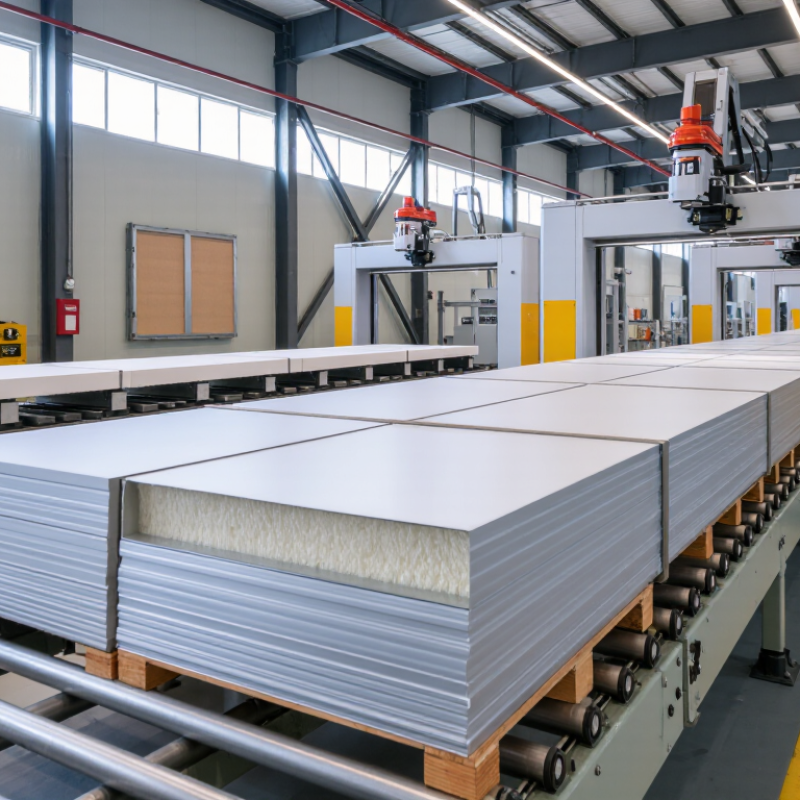
China Best Polyurethane Insulation Panel Manufacturer?

What Is a Polyurethane Insulation Panel?

A polyurethane insulation panel is a rigid board with a closed-cell foam core between protective facing layers. It slows heat transfer through walls, roofs, cold rooms, and factory buildings. Its thermal conductivity is commonly around 0.022–0.028 W/m·K, depending on density, facing, temperature, and testing method. Lower values usually mean better insulation, but laboratory figures are not the whole story.

The International Energy Agency reported in Buildings 2023 that buildings consumed about 30% of global final energy in 2022. Better insulation can reduce heating and cooling demand, especially where temperature changes are severe.

In practical installation, a 100 mm panel feels light, rigid, and smooth. Its tongue-and-groove joint should close tightly, without visible gaps. Moisture control matters too. A small opening can weaken real performance over time. I have seen specifications look excellent, yet poor cutting and careless sealing reduced the result. That gap deserves more attention.

Tips: Check the declared thermal conductivity under EN 13165 or an equivalent standard. Compare fire classification, water absorption, joint design, facing durability, and tested thickness. Ask for independent test reports, not only sales claims. A thicker panel is not automatically better if the supporting structure, ventilation, or installation quality is unsuitable. Local climate data and building codes should guide the final selection.

Why Choose a Chinese Polyurethane Insulation Panel Manufacturer?

Why Choose a Chinese Polyurethane Insulation Panel Manufacturer?

China offers a deep manufacturing base for polyurethane insulation panels. The International Energy Agency reports that buildings consume about 30% of global final energy. Better envelope insulation can reduce heating and cooling demand. Polyurethane panels provide low thermal conductivity, consistent thickness, and fast installation. These features suit cold storage rooms, warehouses, workshops, and agricultural buildings.

Factory experience matters. Established Chinese producers often operate continuous foaming lines, automated cutting equipment, and in-house testing laboratories. Buyers should request thermal conductivity results, core density records, dimensional tolerances, and fire-performance documentation.

The 2023 UNEP Global Status Report for Buildings and Construction highlights the construction sector’s large energy and emissions burden. This supports choosing materials that improve operational efficiency, not merely appearance.

Pricing is another practical advantage. China’s broad supply chain can reduce costs for steel skins, chemicals, packaging, and container loading. However, low prices need careful examination. A thinner panel may weaken thermal performance. Poor edge sealing can also create moisture problems.

I would compare tested specifications, not brochure language. Ask for production samples. Check joint fit with a simple dry assembly. Small mistakes become expensive on site.

Not every factory is equally reliable. Some suppliers communicate well but provide incomplete test evidence. Independent inspection can reveal this early. Clear drawings, agreed tolerances, batch records, and pre-shipment checks improve accountability. The best choice is not automatically the cheapest Chinese manufacturer. It is the one that can repeatedly deliver documented performance, stable quality, and practical technical support.

How Are Polyurethane Insulation Panels Manufactured?

China Best Polyurethane Insulation Panel Manufacturer?

How Are Polyurethane Insulation Panels Manufactured?

Manufacturing polyurethane insulation panels begins with careful raw material inspection. Steel, aluminum, or other approved facings are checked for cleanliness and thickness. The polyurethane core uses polyol, isocyanate, and a controlled blowing system. It starts with control. Small errors matter. Technicians adjust the formulation according to panel thickness, density, and required thermal performance.

During production, a forming line unwinds the facings at a steady speed. A mixing head distributes the liquid ingredients between them. The mixture expands quickly and bonds to both surfaces. A heated laminator maintains pressure while the core cures. Temperature, line speed, and foam expansion must remain balanced. If the mixture expands unevenly, the panel may show weak edges or internal voids. These defects are not always visible immediately.

After curing, machines trim the edges and cut panels to exact dimensions. Quality teams check density, thickness, flatness, adhesion, compressive strength, and thermal conductivity. Fire performance is tested under applicable standards. Samples should come from different positions in the production run, not only from the first panel. This step is easy to underestimate. Not every batch behaves identically. Humidity, storage time, and minor equipment changes can affect results. Experienced manufacturers record these variables and adjust the process before the panels reach construction sites.

What Quality Standards Should Manufacturers Meet?

China Best Polyurethane Insulation Panel Manufacturer?

What Quality Standards Should Manufacturers Meet?

A reliable polyurethane panel manufacturer must prove performance, not merely advertise a low thermal conductivity. EN 13165 requires declared properties for factory-made rigid polyurethane insulation products. Test records should cover thermal resistance, density, dimensional stability, compressive strength, and water absorption. A panel that looks smooth may still fail after repeated temperature changes.

Fire performance deserves close inspection. Manufacturers should classify panel reactions under EN 13501-1 and provide test evidence from accredited laboratories. Joint design also matters. A well-tested core cannot compensate for open seams, weak facings, or poor edge alignment. In practical factory audits, inspectors often check production temperature, mixing ratios, curing time, and batch traceability. Small process changes can create large insulation gaps.

Energy data gives this issue wider importance. The UNEP Global Status Report for Buildings and Construction 2023 reported that buildings and construction consumed about 34% of global energy and produced around 37% of energy- and process-related carbon dioxide emissions. Better panels can reduce operational demand, but only when installed correctly and verified over time. ISO 9001-based quality control can support consistent production, while ASTM C1289 may provide an additional reference for faced rigid cellular insulation testing. Yet certificates are not the whole answer. Request recent test dates, sample conditioning details, and production-batch records. Some manufacturers publish ideal laboratory values only. That is a weakness worth questioning.

China Best Polyurethane Insulation Panel Manufacturer? - What Quality Standards Should Manufacturers Meet?

Quality Dimension Relevant Standard or Test Method What the Manufacturer Should Demonstrate Recommended Verification Evidence
Product Definition and Scope EN 14509 for factory-made double-skin metal-faced insulating sandwich panels A clearly defined panel construction, including core type, metal facings, joint design, dimensions, tolerances, and intended application. Current technical datasheet, product drawings, declared application range, and controlled production specifications.
Polyurethane Core Quality EN 13165 for factory-made rigid polyurethane or polyisocyanurate thermal insulation products Consistent core density, closed-cell structure, dimensional stability, and declared thermal performance appropriate to the product design. Independent laboratory reports, batch records, density checks, and production-control results.
Thermal Conductivity EN 12667, EN 12939, or ASTM C518, depending on the declared product and market A declared thermal conductivity or thermal resistance measured under defined test conditions. Lower thermal conductivity generally indicates better insulation, but design thickness and ageing must also be considered. Accredited test report stating specimen thickness, mean temperature, conditioning, test uncertainty, and measured values.
Declared U-Value or R-Value ISO 6946 for thermal resistance and thermal transmittance of building components Thermal calculations that account for panel thickness, joints, surface resistances, fasteners, and other relevant thermal bridges. Calculation sheets, declared values, design assumptions, and test data that support the published performance.
Fire Reaction Performance EN 13501-1 or ASTM E84, according to the target market and building code A verified fire classification or flame-spread result for the complete panel assembly, not only for an isolated foam sample. Fire-test report identifying the exact core, facings, coatings, joint configuration, thickness, and test orientation.
Fire Resistance Where Required EN 13501-2, EN 1364, EN 1365, or applicable local fire-resistance methods Evidence of the time period for which the complete wall, roof, or ceiling assembly maintains integrity, insulation, or load-bearing capacity, where required by the project. Assembly-level fire-resistance report and installation conditions matching the proposed project.
Mechanical Strength EN 14509 mechanical performance requirements and relevant ASTM or ISO structural test methods Documented compressive, tensile, shear, bending, and fastener-related performance suitable for the specified span, wind load, snow load, and service conditions. Load-span tables, laboratory test results, structural calculations, and declared design limitations.
Dimensional Accuracy EN 14509 dimensional tolerances and the manufacturer’s approved inspection plan Consistent thickness, width, length, squareness, flatness, joint geometry, and metal-facing alignment within declared tolerances. Incoming and final inspection records, calibrated measuring equipment, and sample inspection reports.
Moisture and Water Tightness EN 14509 performance requirements and project-specific water or air-leakage testing Reliable joint sealing, compatible coatings, protected cut edges, and resistance to water penetration under the intended installation conditions. Joint-detail drawings, water-tightness test results where applicable, sealant specifications, and installation instructions.
Metal Facings and Corrosion Protection EN 10143 for continuously hot-dip coated steel sheet tolerances and ISO 12944 for corrosion-protection considerations Traceable steel grade, coating type and mass, paint system, coating thickness, and environmental suitability for the project location. Mill certificates, coating certificates, paint-system data, thickness measurements, and corrosion-environment recommendations.
Ageing and Dimensional Stability EN 13165 ageing and dimensional-stability provisions Thermal performance and dimensions remain within declared limits after conditioning and ageing relevant to the product category. Ageing test results, dimensional-stability data, and declared long-term thermal values where applicable.
Factory Production Control ISO 9001 quality-management principles and product-specific factory production-control requirements Controlled procedures for raw-material approval, formulation or bonding, lamination, curing, inspection, nonconformity handling, and corrective action. Quality manual, process-control plan, calibration records, audit records, batch traceability, and corrective-action reports.
Environmental and Health Documentation Applicable chemical regulations, safety data requirements, and project-specific environmental declarations Accurate information on blowing agents, restricted substances, handling precautions, recyclability, and end-of-life considerations. Safety Data Sheets, declarations of performance where applicable, environmental product information, and compliance statements.
Traceability and After-Sales Support Manufacturer’s documented traceability and technical-support procedures Each production batch can be linked to raw materials, inspection results, production date, panel specification, and delivery records. Batch labels, certificates of conformity, warranty terms, installation manuals, storage guidance, and response procedures for complaints.

Note: The applicable standards, test methods, and acceptance levels depend on the destination market, building code, panel application, and complete assembly design. Test reports should identify the exact panel construction being supplied.

How to Select the Best Manufacturer for Your Project?

Choosing the right polyurethane insulation panel manufacturer requires more than comparing quotations. Start with your project conditions: roof or wall use, target U-value, panel thickness, temperature range, humidity, and local building requirements. A capable manufacturer should explain how core density, thermal conductivity, joint design, and facer materials affect performance. Ask for recent laboratory reports, production tolerances, fire-test results, and certificates that can be independently verified.

Visit the factory if possible. Watch how panels are foamed, cut, cured, and packed. Check whether each batch has traceable records, rather than relying on attractive samples. Request a sample panel and inspect its edges, surface flatness, tongue-and-groove fit, and adhesive bonding. Small gaps can create thermal bridges. They matter on site. Confirm monthly capacity, lead times, replacement procedures, and technical support during installation. A manufacturer with experience in cold storage should discuss vapor control and panel joints, not only selling price.

I have learned that a polished brochure proves very little. One supplier may offer excellent laboratory values but weak delivery control. Another may communicate well but lack consistent quality records. This is where careful questioning helps. Ask how rejected panels are handled, how dimensions are measured, and who approves final loading. Do not accept vague promises. Still, specifications can change during production, and even a careful selection may miss a site problem. Leave room for inspection, testing, and correction before full installation.

China Best Polyurethane Insulation Panel Manufacturer? How to Select the Best Manufacturer for Your Project?

Panel thickness is a practical starting point when comparing polyurethane insulation manufacturers. The chart shows the calculated thermal resistance of typical panel thicknesses using a representative thermal conductivity of 0.024 W/m·K.

Thermal resistance is calculated as R = thickness ÷ thermal conductivity. The values exclude surface resistances, joints, fasteners, moisture effects, and long-term aging. When selecting a manufacturer, also verify declared thermal conductivity, dimensional tolerances, compressive strength, fire performance, facing quality, and test documentation.

FAQS

What quality evidence should a polyurethane insulation panel manufacturer provide?

Request recent test reports covering thermal resistance, density, dimensional stability, compressive strength, and water absorption. Laboratory values alone are insufficient. Ask for production-batch records and sample-conditioning details.

How should fire performance be evaluated?

Ask for reaction-to-fire classification under EN 13501-1 and reports from accredited laboratories. Review the actual test date. Fire performance also depends on facings, joints, and installation quality.

Why are panel joints important?

Open seams and poor edge alignment can create thermal bridges and moisture paths. Inspect tongue-and-groove fitting, surface flatness, and adhesive bonding. A strong core cannot repair weak joints.

What project details should guide panel selection?

Define roof or wall use, target U-value, thickness, temperature range, humidity, and local building requirements. Cold-storage projects need careful vapor control. The cheapest option may not fit the conditions.

What should buyers inspect during a factory visit?

Observe foaming, cutting, curing, packing, and batch labeling. Check mixing ratios, production temperature, and curing time. Small process changes can create large insulation gaps. I would inspect twice.

How can buyers verify consistent production quality?

Request dimensional tolerances, traceable batch records, rejected-panel procedures, and final-loading approvals. Compare the supplied sample with later production panels. A polished sample proves very little.

Which standards may support quality control?

EN 13165 can guide declared properties for rigid polyurethane insulation products. ISO 9001-based controls may support consistent manufacturing. ASTM C1289 can provide an additional testing reference for faced insulation. Certificates are not the whole answer.

What delivery and installation questions should buyers ask?

Confirm monthly capacity, lead times, replacement procedures, and technical support. Ask how installation problems are corrected. Leave room for inspection before full installation. Plans sometimes miss site realities.

Conclusion

A Polyurethane Insulation Panel is a lightweight building product made with a rigid polyurethane core between protective surface layers. It provides excellent thermal insulation, moisture resistance, and structural efficiency, making it suitable for cold rooms, warehouses, industrial facilities, and commercial buildings. Choosing a Chinese manufacturer can offer flexible production capacity, competitive pricing, customized designs, and practical experience in serving different project requirements. However, buyers should evaluate suppliers carefully rather than selecting only by cost.

The manufacturing process generally includes preparing the facing materials, mixing and injecting the polyurethane components, forming the insulated core under controlled conditions, curing, cutting, and conducting final inspections. Reliable manufacturers should meet relevant quality, fire-performance, environmental, and product-safety requirements, while maintaining consistent thickness, density, bonding strength, and dimensional accuracy. To select the best manufacturer, compare technical capabilities, testing procedures, production capacity, customization options, delivery reliability, documentation, and after-sales support. A qualified supplier should communicate clearly and provide samples, specifications, and quality evidence that match the project’s application and performance expectations.

Mason

Mason

Mason is a seasoned marketing professional with a deep expertise in the company's offerings and a passion for driving brand awareness. With a strong background in digital marketing strategies, he has an innate ability to connect with diverse audiences and effectively communicate product benefits.......